Materials & Standards
Organic Cotton Bedding Certifications: What GOTS Does—and Doesn’t—Tell You
A certification label can make a complicated supply chain look reassuringly simple. GOTS offers meaningful information about organic fibers and textile processing, but it is not a verdict on every aspect of a sheet. To understand what you are buying, read the standard alongside the fabric, finish, construction, and care instructions.
There is a particular kind of certainty that comes in small print. A product page says “GOTS certified,” and the phrase seems to settle several questions at once: what the cotton is, how it was processed, whether the product is safe, and perhaps even whether it will feel good against the skin at three in the morning. The label does not settle all of them. It does, however, give shoppers a substantial place to begin.
GOTS—the Global Organic Textile Standard—is a voluntary standard for organic textiles. Its purpose is broader than confirming that a fiber began as organically grown cotton. It sets requirements for textile processing and for certain environmental and social practices across the chain of production. That breadth is important. A field, a spinning mill, a dye house, and a sewing facility are not the same place, and a finished sheet passes through more than one pair of hands.
For bedding shoppers, the useful question is not simply, “Is this certified?” It is: “What, exactly, does the certification cover, and what other details help me judge whether this particular sheet suits my home?” The answer lies in combining the standard’s scope with close reading of the product description—not in asking one seal to do the work of an entire investigation.
What GOTS is designed to cover
GOTS establishes requirements for textiles made with organic fibers and addresses stages of processing and manufacture. Depending on the product and the claims made, this can include rules governing chemical inputs, wastewater treatment, environmental management, and working conditions. The standard is administered through independent certification bodies, which assess relevant operators and facilities against its requirements.
This matters because “organic cotton” describes the agricultural origin of the fiber, while a textile’s journey continues long after harvest. Cotton is cleaned, spun into yarn, woven or knitted, colored or finished, and made into a final article. A standard that considers processing is attempting to address a larger portion of that journey than a claim about raw fiber alone.
GOTS certification is not simply a manufacturer’s promise, nor is it a universal label for every item made by a company that sells certified goods. Certification and product claims should be read in relation to the specific article and the applicable certification records. A brand can offer both certified and uncertified products. Even within a collection, details may differ by item, color, production run, or market.
The standard has requirements for different levels of organic fiber content, and its labeling rules distinguish between them. Broadly, products with at least 95 percent certified organic fibers may use the “organic” label grade, while products containing at least 70 percent may qualify for the “made with organic” grade, subject to the standard’s other requirements. The precise wording and permitted claims depend on the applicable GOTS version and certification. When a page makes a specific claim, look for the stated standard, label grade, and certification details rather than relying on a familiar phrase in isolation.
A useful certification claim is therefore more than a mood. It should be traceable to a certified product and the relevant certification framework. If a listing is vague, ask the retailer or manufacturer for the certification details; if there is a current certificate or verification resource available, consult it. This is not suspicion for its own sake. It is what a standard is for: turning broad assurances into claims that can be checked.
What the label doesn’t promise
GOTS does not tell you whether a sheet will feel crisp, silky, heavy, or cool. It does not specify that percale is preferable to sateen, that one thread count is ideal, or that a fitted sheet will stay put on a particular mattress. Those are questions of fiber quality, yarn, weave, finishing, dimensions, and personal preference.
Nor should certification be mistaken for a medical claim. It does not establish that a textile prevents allergies, improves sleep, or is suitable for every person with sensitive skin. It is reasonable to value requirements concerning organic fibers and processing, but a certification is not a diagnosis, treatment, or guarantee of an individual health outcome.
“Organic” also does not mean that no substance of any kind was used at any stage. Textile production requires inputs, and the standard sets rules around permitted substances and processes. A thoughtful reading avoids two opposite errors: treating the word as proof of absolute chemical absence, or dismissing the certification because manufacturing is not literally substance-free. The relevant issue is what the standard requires, how the product was certified, and whether the claim is accurately presented.
GOTS alone does not provide a complete measure of a product’s total environmental footprint. It cannot, by itself, tell you the full effect of a garment or textile’s transport, packaging, useful life, laundering, or eventual disposal. Nor does it mean every certified product has identical labor practices beyond the standard’s requirements, identical water use, or identical durability. Standards draw boundaries. Their value depends partly on understanding where those boundaries are.
And certification is not a substitute for product-level disclosure. The label will not tell you the fitted sheet’s pocket depth, whether the flat sheet has a hem, which fastener holds a duvet cover closed, or how the fabric is meant to be washed. These are unglamorous details. They are also the ones that determine whether a lovely sheet becomes a familiar part of a household or an expensive object that is forever slipping off the mattress.
The fabric still has a character of its own
Once certification has answered what it can, the fabric deserves its own reading. Percale, for instance, is a plain weave that generally produces a matte surface and a crisp hand. Many sleepers choose it for that fresh, less-clinging feel. Sateen, with a different weave structure, is often smoother and more lustrous. Neither weave is a moral improvement on the other. They are different ways of arranging yarn, with different effects on touch and drape.
Thread count—the number of threads counted within a defined area of fabric—can be useful context, but it is not a complete measure of quality or comfort. Yarn size, fiber length, weaving, finishing, and construction all influence the result. A very high number on a product page cannot tell you everything about how the textile will perform. For percale, the appeal may be its airy, crisp structure rather than a particularly grand figure.
Fiber composition is another independent detail. “100% organic cotton” describes the stated fiber content and organic claim; it does not, on its own, reveal the cotton’s hand, the yarn’s construction, or the fabric’s weight. If a listing identifies where the cotton was grown and woven, that information adds useful context, though origin alone is not proof of a particular quality level. The same is true of a proprietary spinning or weaving process: it may help explain how a maker approaches the fabric, but the phrase is not a certification in itself.
Finishing deserves particular attention. A textile may be treated or softened to alter its feel, appearance, or performance. When a product description says a fabric is finished with a plant-based softener, that is a specific claim about the finish—not a synonym for GOTS and not a guarantee of a certain sensation for every sleeper. If finishing is important to you, look for named details and ask questions where the description is unclear.
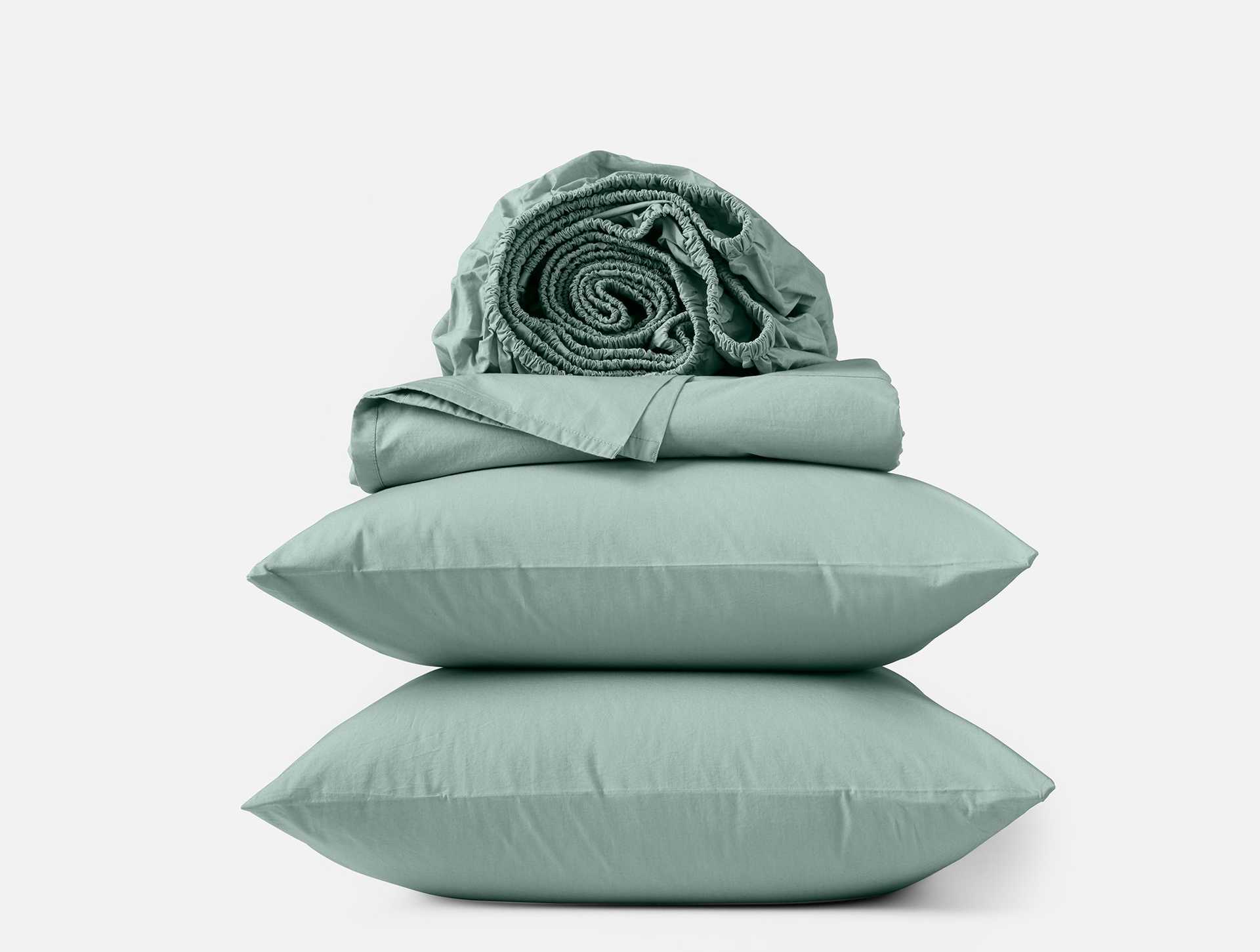
For example, the Refined Organic Percale Sheet Set is described as GOTS-certified organic cotton, with a percale weave, plant-based softener, a seven-inch hem on the flat sheet and pillowcases, and a fitted-sheet pocket described as fifteen inches deep. Those details answer different questions. The certification addresses the applicable organic textile standard; the weave describes the fabric’s construction; the measurements and care instructions speak to day-to-day use. One does not replace the others.
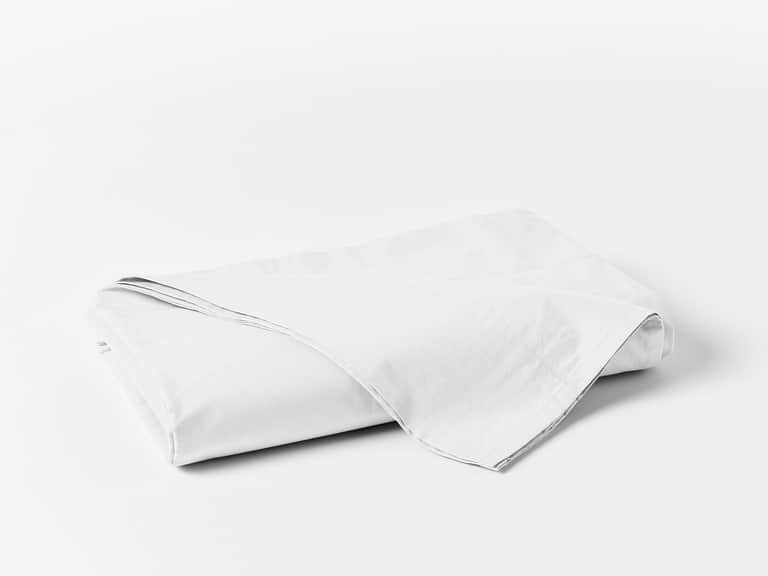
The Refined Organic Percale Flat Sheet likewise lists organic cotton, a percale construction, a seven-inch hem, and care guidance. Its product details identify GOTS and Fair Trade claims. These are not interchangeable credentials: each refers to its own standard or program, with its own scope. A shopper can value both while still asking what each one verifies for this particular product.
Read care instructions as part of the standard of living
A sheet’s life is not spent in a certification document. It is spent being slept on, washed, dried, folded, and—occasionally—found still damp in the washing machine the next morning. Care instructions are not an afterthought to sustainability or quality. They help show what ordinary ownership asks of the fabric.
Many organic cotton percale listings recommend a cold wash on a gentle cycle, often with like colors, followed by low-temperature tumble drying. Some advise removing the sheets promptly and mention warm ironing as an option. The product’s own care label should take precedence over a generalized rule, since finishes and construction can vary. Washing with a compatible load and avoiding unnecessarily harsh treatment may help preserve fabric, color, and seams. Following the directions is usually more useful than applying a confident internet rule to every cotton textile.
Care is also where claims meet habit. A durable sheet that is comfortable enough to use for years may be a more practical choice for a household than a more delicate fabric that requires special handling. Conversely, a person who enjoys ironing may find a crisp percale entirely agreeable. The best decision is not the one with the most impressive list of adjectives; it is the one whose care, fit, and feel make continued use likely.
A small, practical reading method
When evaluating an organic cotton bedding listing, read it in layers. Begin with the exact claim, then move outward into the details a certification cannot supply.
- Identify the certified claim. Look for the full name of the standard, not only the word “organic.” Check whether the claim refers to the specific product and whether the label grade or fiber-content details are provided.
- Check the material. Note whether the product says 100 percent organic cotton or gives a blended composition. A certified organic fiber claim and a general natural-material claim are not the same thing.
- Separate credentials. If the listing mentions GOTS, Fair Trade, or another certification, consider each claim on its own terms. One standard should not be assumed to cover everything addressed by another.
- Read the construction. Look for weave, hems, pocket depth, closure details, and what is included. A sheet set and a single fitted sheet are not equivalent purchases, however similar their names may sound.
- Notice the finish. If a finish or softener is named, treat that as additional product information. If the language is vague and the detail matters to you, seek clarification.
- Use care guidance as evidence of fit. Compare washing and drying instructions with what you can realistically do. The best bedding is bedding you can maintain without making laundry a separate profession.
- Ask for documentation when necessary. If a claim is important to your choice and the listing does not explain it, contact the seller or manufacturer. A specific question—about the product’s certification status, for instance—is often more productive than asking whether a brand is “sustainable.”
This method is deliberately modest. It does not assign a single score to cotton, workers, chemistry, comfort, and environmental impact. It acknowledges that a sheet has several lives at once: as a certified textile, a woven surface, a household object, and a material that will eventually wear out. The label illuminates one part of that picture. The product details bring the rest into focus.
A cleaner distinction between air and fabric
In a home organized around cleanliness, it can be tempting to let one idea spread across the whole room. A purifier addresses airborne particles and other pollutants according to its filtration system; a bedding certification addresses specified textile materials and processes. These subjects can be part of the same household conversation, but they are not the same intervention. A sheet’s certification does not measure room air, and an air purifier does not certify the cotton.
That distinction is useful because it keeps claims in their proper lane. People often choose bedding for touch, temperature, laundering, materials, and sourcing. They may also consider ventilation and air filtration for the room. Each decision has its own evidence and limits. Combining them into a general promise of “clean living” can sound persuasive while making it harder to determine what has actually been measured.
What a good label can—and cannot—do
GOTS is useful precisely because it has a defined scope. It can help a shopper distinguish a textile made under a recognized organic standard from one supported only by an unqualified marketing phrase. It considers organic fiber content and aspects of processing, and it provides a framework against which claims can be assessed. That is meaningful information, particularly in a supply chain where the cotton’s origin and the finished sheet’s manufacture may be separated by many steps.
But the label is not the sheet. It cannot describe the quiet snap of a crisp percale pillowcase, the comfort of a correctly sized fitted corner, or the small irritation of a care label that asks more than a household can give. Nor can it offer a complete account of every environmental and social question a buyer might have. The honest reading of a certification is neither reverence nor cynicism. It is attention.
So read the label, then keep reading. Find the fiber composition, the weave, the finish, the hems, the pocket depth, and the care instructions. Compare claims that are often presented together but cover different things. Ask for clarification when a product description leaves a material point uncertain. In the end, a certification works best not as a curtain drawn over the textile, but as one clear window into how it came to be.