Indoor Air & Home Fragrance
Reed Diffusers and Indoor Air: Fragrance, Ventilation, and Practical Use
A reed diffuser can lend a room a quiet, persistent fragrance. It cannot clean the air. Knowing the difference makes it easier to enjoy scent without mistaking a pleasant atmosphere for a healthier one.
There is a particular domestic ambition in wanting a room to smell like itself, only better. A little green note in the hallway, perhaps, or something floral and woody in a bedroom that has spent the day closed against weather and traffic. A reed diffuser offers this transformation without flame, plug, or visible machinery. It sits quietly on a shelf, its sticks rising from a vessel, while fragrance makes its gradual passage into the room.
That passage is evaporation. Fragrance liquid moves up the porous reeds, reaches the exposed surface, and disperses into the surrounding air. The result may be subtle or pronounced, depending on the formula, the number and condition of the reeds, the room’s size, and how much air is moving through it. A diffuser is therefore a scenting device. It does not trap dust, capture pollen, or remove gases and particles from indoor air.
This distinction sounds simple, but it matters. Fragrance can make a space feel fresh while leaving its air quality unchanged. Ventilation and filtration serve different purposes; neither can be replaced by the pleasant impression of a clean-smelling room. The most thoughtful approach is not to choose between fragrance and air care, but to understand what each can and cannot do.
What a reed diffuser actually does
In a reed diffuser, liquid fragrance is drawn upward through narrow channels in each stick. Once the liquid reaches the exposed end, volatile aromatic compounds enter the air. This process continues while the reeds remain in the liquid, though its pace varies with conditions. Warmth and moving air can increase evaporation; a cooler, still room may release scent more slowly. As the liquid level falls, the fragrance may become less noticeable, and the reeds may eventually become saturated or obstructed by residue.
The mechanism is modest, almost old-fashioned. No fan pushes air through a filter. No membrane separates one substance from another. The diffuser does not circulate the room’s air or collect material from it. It adds aromatic compounds to the air so that they can be perceived by smell. This is why describing a diffuser as an air purifier would be inaccurate, even if its fragrance evokes a sense of freshness.
That sensory effect is real as an experience, but it is not evidence of pollutant removal. A room may smell fragrant and still contain airborne particles, cooking emissions, or gases from household products. Conversely, a room with little detectable odor is not necessarily free of pollutants. Smell is one cue among many, and it is a particularly unreliable measuring instrument for some substances.
For anyone seeking to reduce airborne particles, a suitable air purifier uses a fan to draw room air through filtration media. A particle filter can capture a portion of suspended particles as air passes through it; activated carbon and related sorbent media may help address certain gases and odors, depending on the filter design and the amount of media. Performance depends on the device, its condition, room size, and how it is used. A reed diffuser does none of these things.
Fragrance and indoor air quality are different questions
Indoor air quality is shaped by more than whether a room smells pleasant. Particles can come from outdoor air, cooking, smoking, candles, cleaning, building work, and ordinary household activity. Gases and vapors may be released by products, materials, or processes used indoors. Moisture, ventilation, and the condition of heating and cooling systems also play a role. The mix varies from one home to another and from one hour to the next.
A diffuser adds fragrance compounds to that mix. It does not follow that every person will react to every fragrance, or that every product poses the same level of concern. It does mean that scent is an additional airborne exposure, and that its acceptability depends partly on the people sharing the space. Some occupants may welcome a light fragrance; others may find it irritating or simply distracting. Sensitivity can also vary over time.
If someone experiences discomfort around a fragranced product, a sensible first step is to stop using it and increase ventilation when practical. Persistent or severe symptoms warrant advice from a qualified health professional. A diffuser should not be used to mask an odor that may signal a problem such as smoke, dampness, a spill, or a malfunctioning appliance. The source needs to be identified and addressed; covering it with another smell does not resolve it.
Air-quality decisions benefit from the same plain distinction. Ventilation brings outdoor air into a space and helps dilute indoor contaminants when outdoor conditions permit. Filtration removes some contaminants from air that passes through a filter. Source control reduces or eliminates emissions at their origin. Fragrance changes the room’s smell. These are separate actions, with different jobs.
Choosing a place for the diffuser
Placement affects both how a diffuser performs and how much fragrance people encounter. A large, open room can disperse a scent more widely than a small, enclosed one. A narrow hallway may carry fragrance into nearby rooms; a bedroom with closed windows may allow it to build. The number of reeds and their exposure to moving air also matter. A spot beside a heating vent, sunny window, or frequently opened exterior door may encourage faster evaporation, making the scent stronger at first and shortening the liquid’s usable life.
Start with a location that is stable, level, and away from children, pets, food-preparation surfaces, and the edge of a shelf. Fragrance liquid can stain or damage some finishes, so a protective tray is prudent. Keep the vessel out of direct sunlight and away from sources of heat unless the product instructions say otherwise. Avoid placing it where a sleeve, bag, or passing hand might knock it over.
Room size is useful context, not a precise formula. There is no universal number of reeds that will suit every space or every person. Begin conservatively, following the maker’s directions, and adjust only if the scent feels too faint or too strong. More reeds generally expose more liquid to the air and can increase fragrance release. If the result becomes overwhelming, removing a few reeds may help; moving the diffuser to a larger or better-ventilated area may help as well.
Shared rooms call for particular consideration. A fragrance that seems mild to one person may be conspicuous to someone who enters from outdoors or has been sitting in a different room. In offices, guest rooms, and other spaces used by people with unknown preferences, a lower-intensity approach—or no fragrance at all—may be the more courteous choice.
Ventilation: the quiet partner
Ventilation does not make every fragrance disappear instantly, and opening a window is not always practical. Outdoor air may be smoky, polluted, very hot, or very cold. Still, when conditions are suitable, fresh-air exchange can reduce the concentration of indoor odors and airborne compounds by diluting them. Use windows, doors, or mechanical ventilation in a way that suits the building and local conditions.
It helps to think of ventilation as ordinary household maintenance rather than a special response to scent. Use kitchen extraction when cooking if available. Keep exhaust fans in good working order. Follow maintenance guidance for heating, ventilation, and air-conditioning systems, including filter replacement. If indoor air is a concern, consider the sources first: reducing unnecessary emissions is often more direct than trying to compensate for them afterward.
An air purifier can be useful in some circumstances, but it is not a substitute for fresh-air exchange or source control. Its effectiveness depends on matching the equipment to the room and the pollutant of concern, then operating and maintaining it as intended. A particle filter is not automatically a solution for every gas or vapor; a fragrance diffuser is not a filter at all. The labels on products matter less than the physical process occurring inside them.
For a fragranced room, practical ventilation might mean airing it briefly when weather and outdoor conditions allow, or using an exhaust fan where appropriate. If the fragrance is persistent, the simplest intervention is to remove the diffuser. Open windows and filtration can be useful complements, but they do not turn a fragrance source into an air-cleaning device.
Using a diffuser thoughtfully
Good use begins with restraint. Follow the product’s instructions for filling, reed quantity, placement, and handling. Do not add liquid to a vessel unless the product is designed to be refilled, and do not mix fragrances or liquids from different products. Keep the container upright and out of reach of children and animals. Avoid contact with eyes and skin, and wash hands after handling the liquid or reeds. If liquid spills, follow the product’s cleanup directions and protect nearby surfaces.
Some diffuser makers suggest turning the reeds to refresh the scent. Doing so can briefly increase fragrance release, but it can also transfer liquid to hands or surfaces. Use care, and do not handle reeds over delicate furniture or fabrics. There is no need to turn them routinely if the fragrance is already strong enough. A smaller number of reeds may provide a softer effect and can reduce the pace at which liquid evaporates.
Keep fragrance away from flames and heat sources, and consult the product label for any additional safety information. A reed diffuser does not burn, but its liquid may still be flammable or otherwise require careful handling. Store refills closed, upright, and according to the label. Do not pour fragrance into sinks or drains unless the instructions explicitly permit it; local disposal guidance may apply.
For homes with pets, children, or people who prefer fragrance-free spaces, placement and access deserve extra attention. A diffuser should not be assumed safe simply because it operates passively. Preventing spills and direct contact is fundamental, and the product’s label should be read rather than treated as decorative fine print. If there is uncertainty about exposure around a particular animal or person, seek relevant professional guidance.
A note on fragrance choices
Fragrance descriptions often use language borrowed from gardens, kitchens, and landscapes. A blend may be called green, floral, citrus, woody, or fresh. These words help convey character, but they do not tell us how every occupant will respond, nor do they establish that a product improves health or air quality. A scent can be beautifully composed and still be too strong for a particular room.
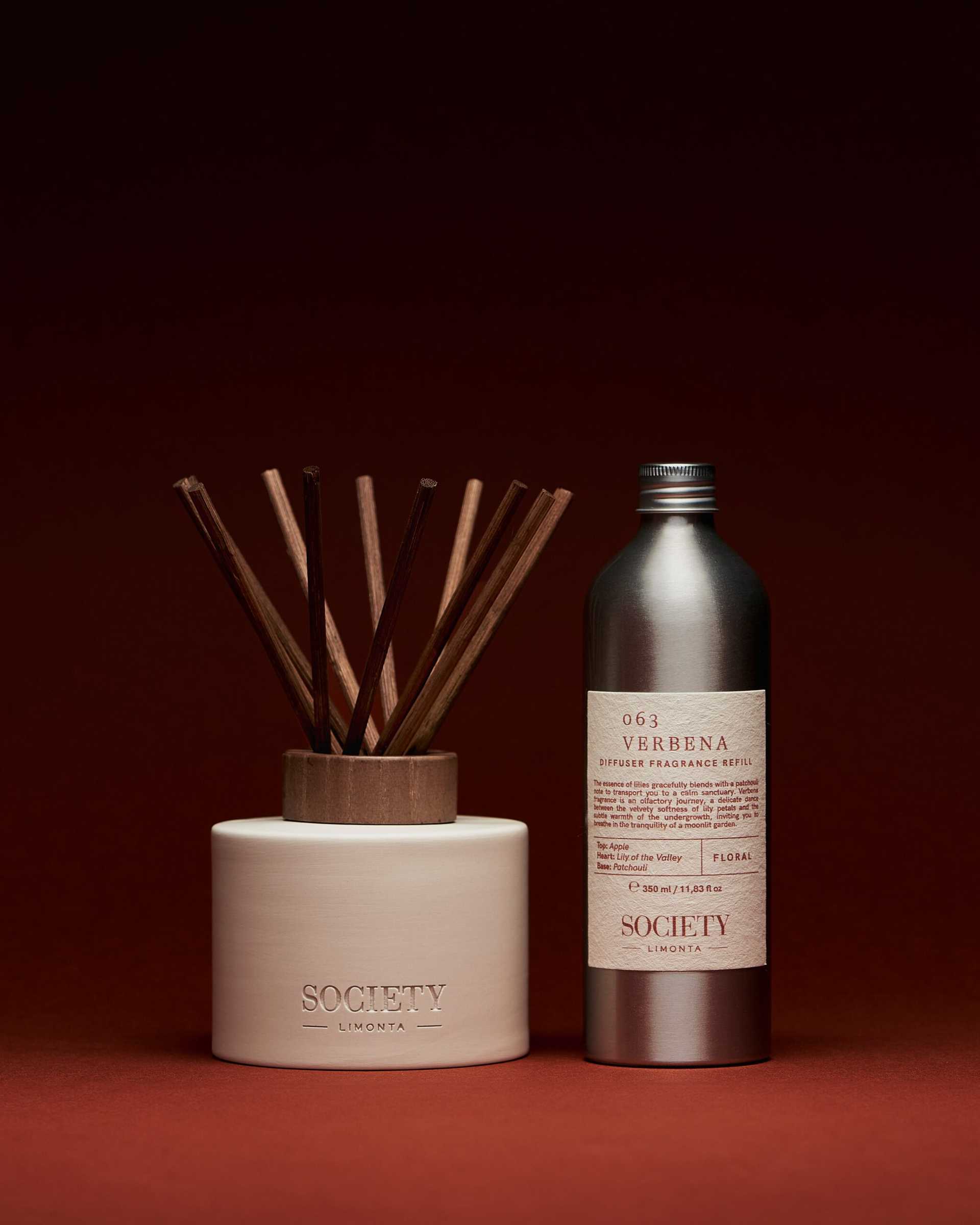
The Verbena Diffuser, for example, is described as combining green, floral lily-of-the-valley notes with a slightly woody patchouli aroma. It is supplied with a refill and twelve wooden sticks, and the stated diffusion duration is at least four months. The maker’s care guidance advises preventing the liquid from touching the container’s exterior to avoid staining. Those details can help someone understand the product’s format and upkeep; they do not make it a means of filtration or ventilation.
When comparing home fragrances, consider not only the scent profile but also where the product will be used, how long people spend there, and whether anyone in the household prefers unscented surroundings. A pleasant fragrance can be an element of domestic comfort. It need not be asked to perform the unrelated task of improving the air.
Common misconceptions
- “It smells clean, so the air must be clean.” A fragrance changes what the nose detects; it does not demonstrate that particles or pollutants have been removed.
- “Reeds filter the air.” Reeds carry liquid fragrance upward. They do not draw room air through a filter or capture airborne material.
- “Ventilation is unnecessary if the room smells pleasant.” Odor and air quality are not interchangeable. Ventilation may still be useful when appropriate, regardless of fragrance.
- “A purifier will remove every fragrance.” Different filtration media address different substances, and no device should be assumed to eliminate every vapor. Check specifications and use the equipment as directed.
- “Natural-sounding scent descriptions guarantee suitability.” Descriptive language is not a safety assessment. Read the label, use the product carefully, and consider the preferences of everyone who shares the room.
These distinctions are not an argument against fragrance. They are a way to make its role legible. A room can be fragrant and ventilated; it can be filtered and unscented; it can be carefully maintained without smelling of anything in particular. The important thing is not to confuse one quality with another.
A practical routine
A simple routine keeps the experience pleasant and the claims modest. First, decide whether fragrance is wanted in that room at all. Choose a stable place away from heat, sunlight, traffic, and delicate finishes. Begin with the product’s recommended setup and a restrained number of reeds. Pay attention over several hours and days, not only in the first moment after opening the bottle.
If the fragrance feels overpowering, remove some reeds, relocate the vessel, or discontinue use. If an odor seems unusual or persistent, look for its source instead of covering it. Use ventilation when outdoor conditions allow, and maintain any air-cleaning equipment according to its instructions. Wash textiles and clean surfaces as appropriate; source control and ordinary housekeeping remain more useful than scent as a response to dust, cooking residue, or dampness.
Finally, check the diffuser periodically. Keep it upright, watch the liquid level, and inspect the area around it for residue or spills. Replace or dispose of the product in accordance with its guidance. The aim is not to make the room smell perpetually like a shop, a garden, or an abstract idea of cleanliness. It is to choose a level of fragrance that feels comfortable, while letting ventilation and filtration do their separate work.
The useful distinction
Reed diffusers are uncomplicated in concept: fragrance travels through the reeds and evaporates into the room. Their appeal lies in that gradual, unobtrusive release. Their limits are just as straightforward. They scent a space; they do not purify it.
Once that distinction is clear, home fragrance becomes easier to use sensibly. Choose a suitable location, keep the intensity moderate, respect product instructions, and make ventilation a separate consideration. If the goal is cleaner air, address sources and use appropriate ventilation or filtration. If the goal is a room that carries a gentle note of verbena, let a diffuser do only what it is made to do.